“...Never doubt that a small group of thoughtful, committed citizens can change the world. Indeed, it is the only thing that ever has.” by Margaret Mead


To view links in sidebar, you may have to be logged into a GOOGLE account.

Showing posts with label property values. Show all posts

Thursday, 8 May 2014

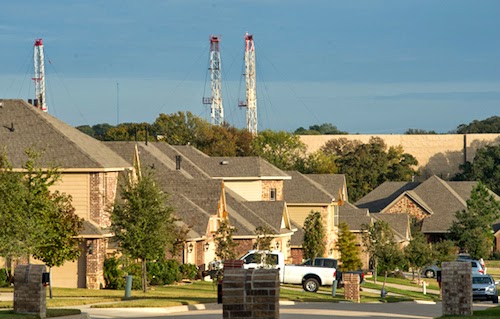
How fracking lowers the value of property and real estate
Save Colorado From Fracking  ::  12 February 2014
According to a study performed in 2001 in Colorado, properties located near fracking areas were prone to loss of value. They were around 18% cheaper than those found further away from oil wells. In fact, the greater the distance between real estate and an oil well, the higher the price. It shows that folks don’t want or need to live in an area full of noise and pollution.
The Colorado School of Public Health claimed that property value decreased during the stages of construction because of natural gas extraction. Other influencing factors are dust, smoke, and traffic. Buyers and sellers are not currently active in areas which are at risk of water and air contamination.
The value of housing in Pennsylvania plummeted 80% in 2011. The only group that benefited from the plunge was Chesapeake Energy, a local drilling company. They were able to acquire more land for fracking purposes.
It’s harder to get a mortgage
Signing gas leases on property has become even harder thanks to regulations imposed by lenders. Fannie Mae and Freddie Mac require that borrowers have permission before they can put their signature onto a lease form.
Some banks have also become wary of giving out mortgages. Oil companies must agree to pay for damage they cause that lowers the value of the land. They must not cause any harmful environmental damage. Other banks ask people to not sign gas leases at all.
They are concerned that drillers may run their machinery illegally, not knowing it could damage the future potential for selling.
Home equity loans are also affected. One customer of a realtor said, “My loan was turned down because I had a contract to lease it with a gas company. I wasn’t capable of finding a mortgage broker who could help me out. I think that a similar scenario to the Flood Zone case is taking place at the moment.”
Getting insurance
One way that owners can reduce the risk of damage is by taking out home insurance. Unfortunately, many insurance providers will not offer contracts on risky real estate. Ben, a citizen of Colorado, said that methane exploded in his house. He was not harmed in the accident, but there was much material damage. His home, originally worth over a quarter million dollars, was devalued to only $60,000.
Realtors in Huerfano County refused to sell or list the property for him. The average person would not want to have a house located near a dangerous spot. After living there for too long, they could develop breathing problems or burns.

Pollution Fears Crush Home Prices Near Fracking Wells
Forbes  ::  Jeff McMahon  ::  10 April 2014
Whether or not fracking causes groundwater pollution, people fear the risk enough that property values have dropped for homes with drinking-water wells near shale-gas pads, according to new research.


Researchers from the Unviersity of Calgary and Duke University studied property sales from 1994 to 2012 in 36 Pennsylvania counties and seven counties in New York. They mapped sales against the locations of shale-gas wells, and they compared homes connected to public drinking-water systems to homes with private wells.
Properties with private wells suffered a loss in value compared to properties connected to a municipal water system, they found, offsetting gains in value from mineral-rights royalties. The loss varied with distance from the nearest shale-gas well. At 1.5 kilometers, properties with private wells sold for  about 10 percent less.
“If these two properties are similar in everything but the type of water they are using, then we find that difference equals negative 10 percent,” said Lucija Muehlenbachs, an assistant professor at the University of Calgary, at a seminar today in Washington D.C. sponsored by Resources for the Future, an environmental policy research institute.
Properties suffered greater losses when closer to shale-gas wells where hydraulic fracturing had been employed.
Within 1 km of shale gas wells, properties with private drinking water wells dropped 22 percent in value. Properties connected to public water suffered no losses, but also showed no net gains.
“If you get closer, if you look at the properties that are only 1 km from a shale gas well, then for the ones that are on groundwater we see a 22 percent loss in property values,” Muehlenbachs said, ”and for the ones that have access to pipe water, there’s zero gain, so essentially all of the positive benefits get wiped out by these negative externalities of having this well pad nearby.”
Such negative externalities include truck traffic, noise, light, and air pollution.
Muehlenbachs conducted the research with Elisheba Spiller and Christopher Timmins of Duke University and published the findings in a discussion paper earlier this year.
At distances greater than 2 km from shale gas wells—what Muehlenbachs calls the vicinity level—the researchers found a net increase in property values that declines over time—”evidence of a small boom-bust cycle at the vicinity level.”
Whether shale gas wells actually cause groundwater pollution is a topic fiercely debated.  

“We don’t know,” said Alan Krupnick, Senior Fellow and Director of RFF’s Center for Energy Economics and Policy. ”What Lucija is getting in her data is people’s preferences and fears. That’s not necessarily reality, that there’s groundwater pollution, there’s just fear that they’re could be.”

One Department of Energy study found no evidence of upper-aquifer groundwater pollution from a Pennsylvania shale gas well.
SWN notifies Kent County of exploratory drilling
Galloway residents still have questions
CBC News  ::  May 07, 2014 

SWN Resources Canada plans to drill exploratory wells in Kent County. (SWN Resources Canada)
Some Kent County residents have questions after SWN Resources sent them a letter letting them know it plans to drill an exploratory well in their area.
Residents of Galloway, near Rexton, say they have questions the company hasn’t answered.
Maurice Albert and his wife say they were notified by SWN last week.
Not only is their home nearby, the Alberts also own land next to the well site.
“We're planning on passing down our land to our kids. What are they going to have to deal with? The resources that we have, the clean water, the clean air. It's a beautiful place to live and I'd hate to see it be ruined,” said Kim.
SWN says it’s trying to reassure residents that won't happen.
The company says it's doing an environmental impact assessment "to identify steps to avoid or mitigate environmental impacts."
It says the exploratory well will be drilled to gather rock samples, but there will be no hydraulic fracturing.
Long-term concerns
Albert says if gas is found in the shale, he's worried for his family's farm.
“It's extremely important to the cranberry farmers because water management is a big thing. They need water for irrigation. And they need it for flooding in the winter time. So they really need good water. If they lose their water their whole investment is gone,” he said.
People who both oppose and support fracking told CBC they want more details from SWN.
Rosella Richard's home is one kilometre from the proposed test well site.
“We never had any conversations with any of them. They mostly talk on TV, but not face to face,” she said.
SWN says it has made copies of its 98-page assessment available at municipal offices.
Richard says the company doesn't understand the community.
“Even though we read that, we don't understand everything, you know what I mean, because we don't have any education,” she said.
In an email, SWN wrote it’s open to meet with groups and organizations that invite the company to speak.

But the company won't say whether it plans to organize a meeting with all affected residents.

Folks, shale gas and SWN are officially in back yards of Kent County.  Our hearts go out to those who are in or near the "Kill Zone".  If not for yourselves, speak up for the children and grandchildren and future generations of Kent County.
Kent South NO SHALE GAS Kent Sud

Friday, 21 March 2014

How Fracking Destroys the American Dream


This is a MUST READ ARTICLE about how fracking has affected the value of neighbourhoods and counties in the US.  The NB Rules for the Industry will not protect New Brunswickers from the same effects.  Is this the future we want for our children and grand children?

Saturday, 22 February 2014

Exxon CEO Rex Tillerson Joins Suit Citing Fracking Concerns, Residents of Dallas Suburb Fight Construction of Tower That Would Provide Water for Drilling
Daniel Gilbert  ::  The Wall Street Journal  ::  February 20, 2014
BARTONVILLE, Texas—One evening last November, a tall, white-haired man turned up at a Town Council meeting to protest construction of a water tower near his home in this wealthy community outside Dallas. The man was Rex Tillerson, chairman and chief executive of Exxon Mobil Corp.  He and his neighbors had filed suit to block the tower, saying it is illegal and would create “a noise nuisance and traffic hazards,” in part because it would provide water for use in hydraulic fracturing. … It also is a core part of Exxon’s business.


While the lawsuit Mr. Tillerson joined cites the side effects of fracking, a lawyer representing the Exxon CEO said he hadn’t complained about such disturbances. “I have other clients who were concerned about the potential for noise and traffic problems, but he’s never expressed that to me or anyone else,” said Michael Whitten, who runs a small law practice in Denton, Texas.  Mr. Whitten said Mr. Tillerson’s primary concern is that his property value would be harmed.  An Exxon spokesman said Mr. Tillerson declined to comment. The company “has no involvement in the legal matter” and its directors weren’t told of Mr. Tillerson’s participation, the spokesman said.
The dispute over the 160-foot water tower goes beyond possible nuisances related to fracking.  Among the issues raised: whether a water utility has to obey local zoning ordinances and what are the rights of residents who relied on such laws in making multi-million-dollar property investments.  The latter point was the focus of Mr. Tillerson’s comments at the November council meeting.  The tower would be almost 15 stories tall, adjacent to the 83-acre horse ranch Mr. Tillerson and his wife own and a short distance from their 18-acre homestead.  Mr. Tillerson sat for a three-hour deposition in the lawsuit last May, attended an all-day mediation session in September and has spoken out against the tower during at least two Town Council meetings, according to public records and people involved with the case.  The Exxon chief isn’t the most vocal or well-known opponent of the tower.  He and his wife are suing under the name of their horse ranch, Bar RR Ranches LLC, along with three other couples.  The lead plaintiffs are former U.S. House Majority Leader Dick Armey and his wife, who have become fixtures at Town Council meetings.  Mr. Whitten, who also represents the Armeys, said they declined to comment.
The water tower is being built by Cross Timbers Water Supply Corp., a nonprofit utility that has supplied water to the region for half a century.  Cross Timbers says that it is required by state law to build enough capacity to serve growing demand.  “We’re a high water-usage area,” said utility President Patrick McDonald.  “People have large lots, lawns, horses, cattle, goats, swimming pools, gardens,” he said.  Cross Timbers, formerly known as Bartonville Water Supply, said it would sell leftover supplies to energy companies during months when overall demand is low.
...
Mr. Tillerson, 61 years old, moved to Bartonville in 2001 and became CEO in 2006.  Since 2007, companies have fracked at least nine shale wells within a mile of the Tillerson home, according to Texas regulatory and real-estate records.  The last to do so was XTO Energy Inc., in August 2009, according to Texas regulators.  Mr. Tillerson had just begun talks for Exxon to acquire XTO.  Four months later, Exxon swallowed its smaller rival for $25 billion, becoming America’s biggest gas producer.  XTO drills and fracks hundreds of shale wells a year, and the Exxon unit has said it recycles water and ships it on pipelines where feasible, in part to reduce truck traffic.
In 2011, Bartonville denied Cross Timbers a permit to build the water tower, saying the location was reserved for residences.  The water company sued, arguing that it is exempt from municipal zoning because of its status as a public utility.  In May 2012, a state district court judge agreed with Cross Timbers and compelled the town to issue a permit.  The utility resumed construction as the town appealed the decision.  Later that year, the Armeys, the Tillersons and their co-plaintiffs sued Cross Timbers, saying that the company had promised them it wouldn’t build a tower near their properties.  They also filed a brief in support of the town’s appeal.
Last March, an appellate judge reversed the district judge’s decision saying he had overstepped his jurisdiction and sent the case back to the lower court, where it is pending.  Meanwhile, the utility has reached out to Bartonville voters, who in November elected two members to the council who criticized the town’s fight against the tower. “The council is currently evaluating all options,” said Bill Scherer, Bartonville’s mayor pro tem.
In the wake of the election, Mr. Tillerson was among those who lined up in a windowless hall to address the council.  He told officials that he and his wife settled in Bartonville to enjoy a rural lifestyle and invested millions in their property after satisfying themselves that nothing would be built above their tree line, according to the council’s audio recording of the meeting.  Allowing the tower in defiance of town ordinances could open the door to runaway development and might prompt him to leave town, Mr. Tillerson told the council.  “I cannot stay in a place,” he said, “where I do not know who to count on and who not to count on.”


You just gotta love the irony.

Here is a direct quote from Rex Tillerson, CEO of EXXON:

"…And as long as we as an industry follow good engineering practices and 
standards, these risks are entirely manageable. And the consequences 
of a misstep by any member of our industry -- and I'm speaking again about 
the shale revolution -- the consequences of a misstep in a well, while large 
to the immediate people that live around that well, in the great scheme of 
things are pretty small…."

Rex W. Tillerson, Chairman and CEO, Exxon Mobil Corporation
June 27, 2012
Council on Foreign Relations 

Wednesday, 29 January 2014

Fracking the dream:  
Drilling decreases property values

Resource Media |November 13, 2013 1:39 pm |
Drilling conflicts are almost always described in the context of their impacts on air, water and health. But increasingly, as the drilling boom sweeps the country, another part of the drilling story is starting to bubble up in drilling hotspots like Colorado, Pennsylvania, New York, Wyoming and Texas. 

Increasingly, oil and gas development is butting up against, and often trampling, the bedrock American principles of property rights and the value of one’s home
Industry estimates peg the number new wells that will be drilled across the U.S. over the next decade at more than 200,000. In this rush to tap once unreachable deposits, oil and gas development is pushing the boundaries of drilling. Innovations like fracking and horizontal drilling mean nothing is out of reach. Once the province of wide open spaces, drilling rigs now regularly inch up and even into communities that never anticipated having to address problems like round-the-clock noise, storage tanks, drums of toxic chemicals, noxious fumes, and pipelines near homes, schools, playgrounds and parks.
This clash of large-scale industrial activity and communities has surfaced a deep rift in the American landscape, where the legal doctrine of split estates allows one party to own mineral rights and someone else to hold the rights to soil and surface. With the oil and gas industry showing little self-restraint in where drilling happens, and almost no regulatory or legal precedents to protect them from having industrial activity in their back yards, communities are fighting back. Increased truck traffic, chemicals, lights, noise, heavy equipment, noxious air emissions and water contamination are liabilities for landowners, to the point that communities in Colorado, New York and other states have taken matters into their own hands.