“...Never doubt that a small group of thoughtful, committed citizens can change the world. Indeed, it is the only thing that ever has.” by Margaret Mead


To view links in sidebar, you may have to be logged into a GOOGLE account.

Showing posts with label Effects of fossil fuel end days. Show all posts

Friday, 21 August 2015

A Trillion Bucks Says You’ll Sell Your Wheels

Todd Neff  ::  Rocky Mountain Institute  ::  17 June 2016

Say goodbye to traffic congestion, parking problems, dirty gasoline… and car driving as you know it. Meet the new mobility, which RMI — with industry partners — is ushering in.

Image copyright Thinkstock / Rafal Olkis.
Though driving is fun for some, for many it’s a simple necessity of getting where we need to when we need to. We pay dearly for that, whether we realize it or not. We spend tens of thousands of dollars — and plenty more on gasoline, maintenance, insurance, and taxes — for an asset that sits parked 95 percent of its life. Then, even though our cars can seat four or more people, we usually drive alone — 75 percent of American commuters are solo. There’s also the interminable traffic congestion, in which we spend an average 38 hours per year. And of course the air pollution from tailpipe emissions, accounting for ~20 percent of all U.S. carbon emissions.

This “privilege” doesn’t come cheap. Americans spend $1.2 trillion a year on our personal mobility — 20 percent of household incomes, on average. That equates to about $0.59 per mile, which adds up quickly when the typical American driver tallies ~13,500 miles per year. And none of those numbers include the additional $2 trillion or so annually that pollution, sitting in traffic, roads and parking lots, and accidents cost us.

But there’s a better way… one that can ultimately save $1 trillion of direct costs, 2 billion barrels of oil, and 1 gigaton of carbon emissions per year, according to Jerry Weiland, a 30-year veteran of General Motors and managing director of RMI’s mobility program. In this not-too-distant future, per-mile mobility costs are slashed from $0.59 to just $0.15. RMI views this opportunity as an enormous prize to be split among consumers, entrepreneurs, wise incumbents, and progressive cities.

The new mobility can save $1 trillion, 2 billion barrels of oil, and 1 gigaton of carbon emissions per year.

This new mobility builds upon RMI’s proud legacy of work on cost-effective, oil-free transportation embodied in the Hypercar concept, Winning the Oil Endgame, and Reinventing Fire. Expanding from the concept of more-efficient, better-designed vehicles, RMI’s team believes the future of mobility will look very different from its past. The confluence of several major trends is the front line of this fundamental mobility transformation.

On the societal front, the rise of peer-to-peer networks, smartphones, apps, and the sharing economy (think AirBnB, Uber, Lyft, Car2Go, ZipCar, and many others) are changing perspectives on whether we own and how we access and use assets like cars and houses. Plus, as a nation we’re driving less. Among Millenials there’s a distinct departure from the car-centric worldview of their Boomer parents, with vehicle ownership and even driver’s license rates on the decline. Meanwhile, total vehicle-miles traveled (VMTs) peaked in 2007, and per-capita VMTs have been declining even more sharply since.

Our vehicles are transforming too, seeming to come out of science fiction, and demonstrating a quantum leap from the internal combustion engine autos we’ve been driving until now: self-driving cars and electric vehicles like the Tesla Model S, Nissan LEAF, Chevy Volt, and BMW i3. Automakers already sell cars with parking automation, adaptive cruise control, lane keeping, and other driver-assist features. And incumbents plus new entrants such as Google and Apple have put millions of miles on self-driving vehicles, which are already legal on the roads in California, Nevada, Florida, Michigan, and Washington, D.C.
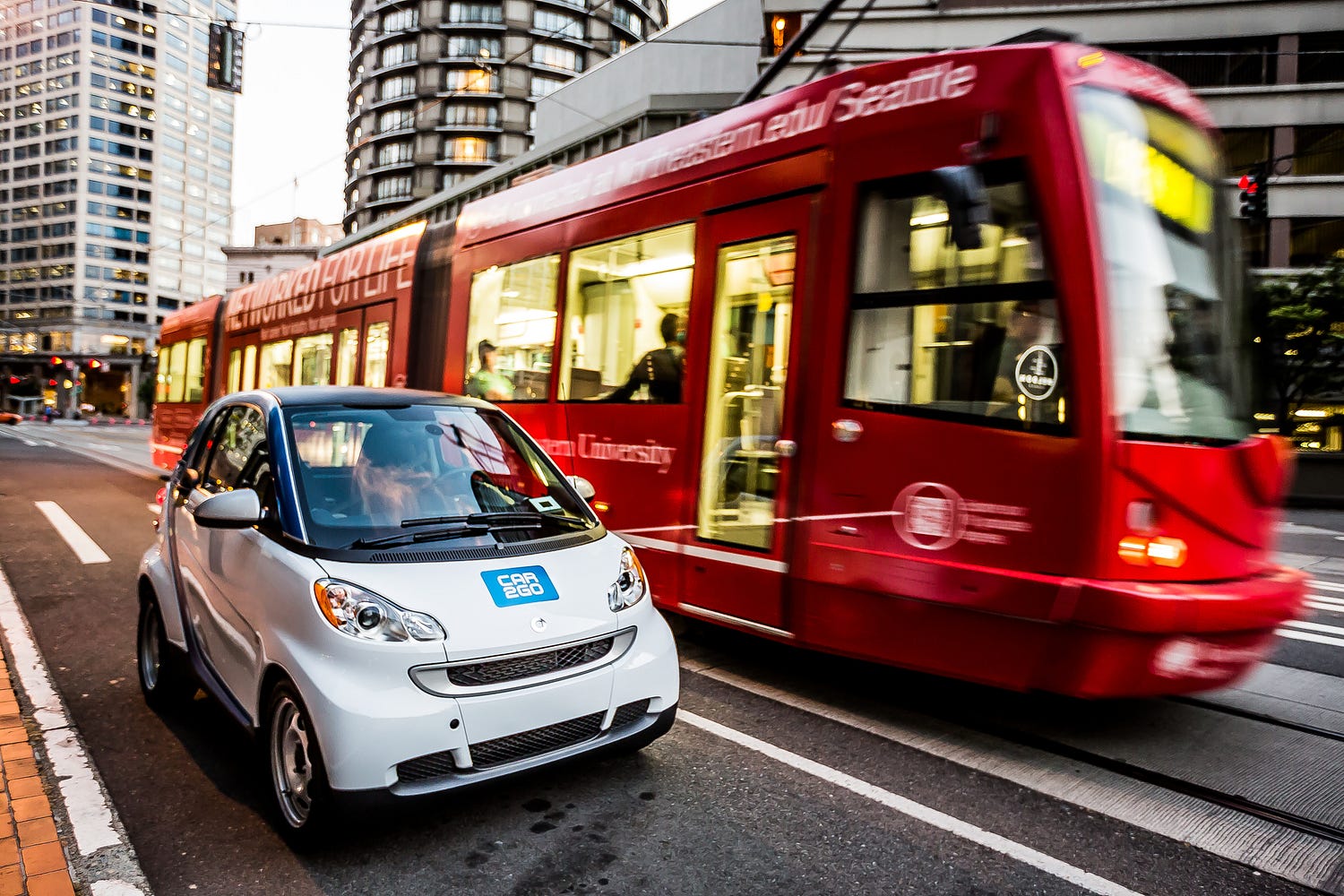
Car sharing and public transit are part of an urban transition to mobility as a service.
Image courtesy of car2go North America.
The sum of these trends is far greater than the parts, and point to a very different future of new mobility with four elements at the core.

The first is mobility as a service. “We’re going to share cars,” says Weiland. “They’re going to be running 12-hour days at very high levels of utilization.” Since the mobility is there when you need it and not when you don’t, it’s essentially “mobility on demand,” like streaming your favorite movie. And when you’re not committed to a single vehicle (the one you own in your garage today, perhaps) then the mobility-as-a-service perspective opens up all sorts of possibilities to you — walking, biking, Ubering, Lyfting, a self-driving car, buses, trains. The new mobility gets you where you want, when you want, how you want.

Underlying mobility as a service is using the right vehicle for the right job. Forget giant SUVs with third-row seats shuttling a single person. The vehicles of the future — a future that will take shape in the next five to ten years, the RMI team says — will be a diverse lot, built for diverse needs. Comfy one-seaters could carry commuters between their homes and bus or train stations, finally cracking the infamous “last-mile” problem that has long vexed transit planners. SUVs might carry people to the mountains or the beach, pickup trucks to Home Depot and back. Minibuses might make sense where big buses now trundle along mostly empty (and thus costing up to 90 cents a passenger mile in many municipalities, says Jonathan Walker, a manager in RMI’s mobility practice).

The vehicles of this future will also be electrified. Why? In a high-utilization mobility future — where fewer vehicles are driving more miles and more hours of the day — operating costs dominate their total cost. That’s one place where electric vehicles (EVs), with an average 120 MPGe, have a huge leg up over gasoline-burning cars, because their drastically lower “fuel” cost more than offsets their higher purchase price. And, since EVs also have far fewer moving parts, Weiland says they can go 300,000 or maybe even 500,000 miles, compared to 150,000 miles on the average late model car. The combination of robustness and low maintenance costs makes EVs ideal for high-volume shared services. That includes corporate fleets, where EVs can seriously trim a company’s operating costs and carbon footprint.

In the new mobility, much higher utilization rates mean we’ll need far fewer cars to move more people more efficiently in less traffic with less cost and less climate impact.

Then there are the aforementioned self-driving vehicles. At first blush, self-driving capability might sound like another cool feature. For maybe $10,000 — the Boston Consulting Group’s estimate for the added cost of that capability and the actual price of California startup Cruise Automation’s Audi self-driving add-on — you can let your car drive you. Catch up on the news, read a book, do some work, take a nap. But think about it: if the car can drive you, why have it just park itself and wait all day for you? Why not share it, let it transport others rather than sit parked waiting for you? Self-driving vehicles thus only further support mobility as a service provided through ubiquitous retail fleets, instead of individually-owned cars.

Finally, there’s mobility-friendly cities, says Greg Rucks, a principal in RMI’s mobility practice. Today’s urban landscapes are built around the automobile: streets clogged with traffic; drivers circling city blocks searching for parking; curbside, garage, and underground parking. Mobility-friendly cities, on the other hand, can trade excess road capacity and parking for more parks… or homes or shops or anything other than catering to the almighty automobile.
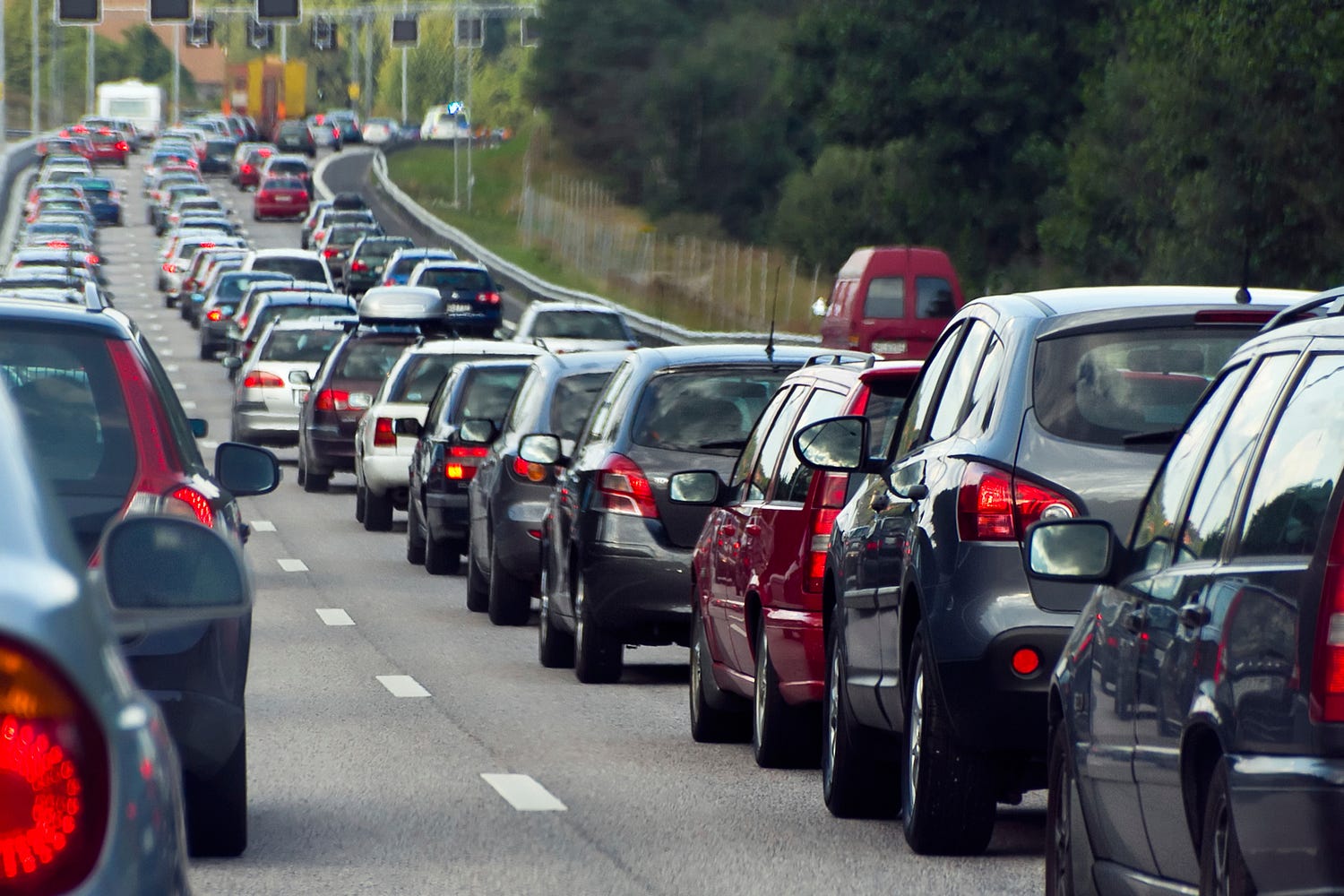
Image copyright Thinkstock / alexandragl1.

The Journey of a Thousand Miles…

There are currently about 253 million registered cars and light-duty trucks on the road in the U.S. With a 2014 population of 319 million, that’s almost one car per person! That won’t be the case in the new mobility, where much higher utilization rates mean we’ll need far fewer cars to move more people more efficiently in less traffic with less cost and less climate impact. Of course, arriving at such a mobility Shangri-La won’t happen overnight, and it won’t be easy.

Weiland, Rucks, Walker, and the rest of the team believe we can reduce the number of urban/suburban vehicles on the road by up to 90 percent. Along the way, we will redefine cities and, probably, American life, just as the horseless carriage once did. The barriers will be formidable. Automakers, insurance companies, and other incumbents won’t be excited to cede 90 percent of a market, Weiland says, and would need to develop completely new business models to stay competitive — just as today’s electric utilities are facing with the rise of rooftop solar.

Psychology may prove a bigger hurdle than technology. People like the idea of being able to spontaneously take off somewhere in their own wheels, whether they do it very often or not. Plus, consumers may be slow to trust self-driving technology and reluctant to cede the steering wheel to a computer “brain” under the hood that’s wirelessly connected to the mobility world around it — even though self-driving cars are already safer than cars with human drivers. Data privacy could be a concern, too, though Rucks says the data at the heart of the new mobility would be anonymized. It’s not your personal secrets that matter, he adds, but rather “the aggregation of data in and across systems.”

“We have to devise a solution that’s 100-percent failsafe,” Weiland says. “The new mobility has to offer people a complete answer, not a partial one. Otherwise you’re not going to get rid of your car.” Or at least one of them as a starting point.

Nobody, the RMI team included, knows where exactly this all might go, and that’s not the point, Walker says. “We want to whet the appetite of businesses to go attack these trillion bucks,” he says. The road ahead looks very different from the one behind. But the question now is who will chart the course, who will come along for the ride, and who will be left standing on the side of the road.

Written by Todd Neff, a freelance writer who specializes in covering energy and climate. He wrote about retail electricity pricing in the Summer 2014 issue ofSolutions Journal.


Friday, 31 July 2015

It's Not Climate Change - It's Everything Change 
by Margret Atwood

Oil! Our secret god, our secret sharer, our magic wand, fulfiller of our every desire, our co-conspirator, the sine qua non in all we do! Can’t live with it, can’t — right at this moment — live without it. But it’s on everyone’s mind.

Back in 2009, as fracking and the mining of the oil/tar sands in Alberta ramped up — when people were talking about Peak Oil and the dangers of the supply giving out — I wrote a piece for the German newspaper Die Zeit. In English it was called “The Future Without Oil.” It went like this:

The future without oil! For optimists, a pleasant picture: let’s call it Picture One. Shall we imagine it?

There we are, driving around in our cars fueled by hydrogen, or methane, or solar, or something else we have yet to dream up. Goods from afar come to us by solar-and-sail-driven ship — the sails computerized to catch every whiff of air — or else by new versions of the airship, which can lift and carry a huge amount of freight with minimal pollution and no ear-slitting noise. Trains have made a comeback. So have bicycles, when it isn’t snowing; but maybe there won’t be any more winter.


(Frank Carroll/NBCU Photo Bank; Visions of America/UIG via Getty Images; J. A. Hampton/Topical Press Agency/Getty Images)
We’ve gone back to small-scale hydropower, using fish-friendly dams. We’re eating locally, and even growing organic vegetables on our erstwhile front lawns, watering them with greywater and rainwater, and with the water saved from using low-flush toilets, showers instead of baths, water-saving washing machines, and other appliances already on the market. We’re using low-draw lightbulbs — incandescents have been banned — and energy-efficient heating systems, including pellet stoves, radiant panels, and long underwear. Heat yourself, not the room is no longer a slogan for nutty eccentrics: it’s the way we all live now.
To finish this wonderful piece and view the photography, please continue on this link.

Tuesday, 28 July 2015

Get Ready for Ugly as Markets Begin to Deal With Climate Crisis

  ::  EcoWatch  ::  28 July 2015 
Advocates of “market-based” climate solutions paint pastel pictures reflecting smoothly adjusting macro-economic models. Competitive markets gradually nudged by carbon pricing glide into a low carbon future in a modestly disruptive fashion, much as sulfur pollution from power plants was scaled back in the 1990’s.
But commodity markets for oil and gas don’t work that way. These real markets are poised to savagely strand assets, upset expectations, overturn long established livelihoods and leave a trail of wreckage behind them—unless climate advocates start owning the fruits of their own success and preparing for the transition. Schumpeter’s destructive engine of capitalism is about to show its ugly side.
oilmarkets650
Markets are abandoning carbon companies—even if society continues to burn far too much of it. Photo credit: Shutterstock
Two powerful forces are currently driving energy markets and climate outcomes.
Fossil fuel prices are indeed opening the door to climate solutions, but not through the gradual carbon pricing mechanisms so favored by economists (and recently, reluctantly beginning to be explored by conservative thinkers). Instead, the divergence between clean energy price curves, which fall rapidly with market share and fossil fuel prices, which rise with consumption, are about to collide explosively.
Second, Investors are indeed, moving away from fossil fuel stocks and bonds, but not out of ethical concern over climate risk, or even an expectation of global regulation of carbon combustion. They are racing to the exit as bloated coal and oil stock values collapse on the other side of the “Commodity Super-Cycle” which until early 2014 was the dominant paradigm.
Two weeks ago I wrote two pieces in Bloomberg Views suggesting that the fossil divestment movement was arguably behind market trends in arguing that coal and oil were bad investments. The following week witnessed a cascade of commentary making my pieces look milquetoast and timid. Markets are abandoning carbon companies—even if society continues to burn far too much of it.
Look at the numbers:
U.S. coal consumption has fallen, in the face of competition from performance (efficiency), alternatives (natural gas) and disrupters (solar and wind.) Five years ago we burned a billion tons of coal; now we burn 850 million tons. Solid progress. But still 850 million tons.
What happened to coal company share values? In the last five years, a coal company has gone bankrupt on the average every month. The second largest U.S. coal company, Alpha, after one bankruptcy and reorganization, was just dumped from the NY Stock Exchange because its price fell below $1.00. Even a coal producer (Walter) whose output, metallurgical coal, still enjoys a strong market had to file for bankruptcy. The biggest U.S. coal company, Peabody, which traded in 2011 at $73, is now selling at $1.29. The bond markets have abandoned coal. All coal company debt is now graded “junk.” In the last quarter the three worst performing major U.S. bonds were all coal:
Alpha Natural Resources: -70 percent
Peabody: -40 percent
Arch: -30 percent
Coal, as an investment class, is effectively finished—coal companies will go through a series of reorganizations. After each one only those with the best balance sheets and cheapest mines will remain. The reclamation bonds which the U.S. government and the State of Wyoming allowed these companies to self-insure against their balance sheets are about to go south, creating sequential calls on capital that will push even more companies first into Chapter 11 and then into Chapter 7. Outside the U.S., 1/6th of Australia’s coal mines now operate at a loss. Companies in the sector are in liquidation, even though the world will use a lot of coal for quite a while to come. Eventually slumping demand will be overtaken by declining production and more mines will become cash flow positive, but existing stakeholders will be liquidated first. That’s the dynamic of shrinking commodity markets—investors, communities and workers lose fast even as markets shrink slowly.
Many investors thought they could be the last to make a profit on conventional telephone land-lines. Someone was that last lucky bottom-feeder. But most of those who entertained that illusion were wiped out. Coal investors can join the line.
But what about oil and gas? The public—and politicians—still view oil as the necessary evil and oil companies as the essential usurers of our dependence. But the markets are not so sure. Since 2011 a “five-point gap has emerged between market valuations for energy companies and the S&P 500, as returns on capital have fallen in the sector.” Federal banking regulators have begun warning lenders that many of the loans made to drillers at the height of the shale rush must be treated as “substandard.”
BP recently earned the dubious distinction of being the first of IOC’s integrated majors to have its bonds de-rated because of potential environmental liabilities from the Deepwater Horizon Spill. Shell was able to finance one of its recent pipeline projects at 23 times its earnings, but its own shares fetch only 9X. From 2006 to 2013 the percentage of Exxon Mobil’s proven reserves made up of tar sands and heavy oil increased from 15 percent to 32 percent. Relying on a larger share of more expensive oil reduced Exxon Mobil’s margins and returns. Its stock value trailed the S&P 500 by 40 percent during those seven years—even as the company used the vast majority of its profits to buy back shares to sustain their value.
Chatham House in a recent analysis commented, “Even before the 2014 oil price collapse, equity investors were concerned that, with few exceptions, many companies in the oil sector were heavily committed to high-cost projects for which they had a poor record of execution.”
Now, with oil less than half its price a year ago, companies are desperately canceling projects; a few months ago $118 billion in oil exploration and development projects had been shelved; this month Wood Mackenzie said the total had risen to $200 billion, a cut of almost 50 percent in investments to replace reserves. The biggest victims: not just U.S. shale producers, but Canadian tar sands, declining North Sea fields and Brazilian deep ocean drilling. Big investors have been hit hard: Carl Icahn and John Paulson have lost hundreds of millions of dollars on their oil bets.
Investor owned oil companies are particularly vulnerable in an oil commodity-cycle price crunch because while their existing reserves include large volumes of relatively cheap to pump legacy reserves, their ability to replace those reserves is highly constrained to the world’s most expensive ultra-deep, super-heavy and wildly remote reserves. “Even before the 2014 oil price collapse, equity investors were concerned that, with few exceptions, many companies in the oil sector were heavily committed to high-cost projects for which they had a poor record of execution.” The remaining untapped cheap or moderately costly oil fields are mostly off-limits to IOC’s, reserved by Russia, Venezuela and Persian Gulf monarchies for their nationally owned oil companies, whose long term business plan is to squeeze the Western IOC’s out of business.
In 1915, as the American economy boomed, the huge supply chain that supported horse-drawn transport—harnesses and horseshoes, wagons and buggies makers (13,000 of them), farriers and blacksmiths, hay balers and feedmills—looked like a robust and vital segment for deploying capital. 1920 was the year of “Peak Horse” in the U.S.. By 1940 it was gone. This was not “low-cost”, incremental progress. It was an economic disruption so fierce that the phrase “buggy-whip maker” became a business simile for loser.
From both the standpoint of barometric pressure and stock market volatility we have sown the winds of fossil fuel capitalism for a decade too long—but bemoaning that fact changes nothing. As Christina Figueres says “Better late than later.” We still have time to prepare for the whirlwind. It will come whether we prepare or not.

Thursday, 16 July 2015

And the Cheapest Electricity in America Is … Solar

John Rogers, Union of Concerned Scientists  ::  EcoWatch  ::  15 July 2015

A Nevada utility and a solar developer have just struck a deal for solar electricity at a price that stands out compared not just to other solar deals, but also to just about any other option for new electricity. Here’s what it and other recent deals say about the future of solar.

Costs for large-scale solar projects dropped by 7 percent last year,
and are down by way more than half since 2009.
Photo credit: John Rogers
Bloomberg’s story on the Nevada deal opens with this (emphasis added):

Warren Buffet’s Nevada utility has lined up what may be the cheapest electricity in the           U.S., and it’s from a solar farm.

“Cheapest” and “solar” aren’t words some folks might expect to see together in something coming out of a financial outfit like Bloomberg. But folks who have been paying attention to solar’s incredible recent price drops in recent years know that the times they are a-changin’.

Best deal in town NV Energy, part of Buffet’s Berkshire Hathaway company, is buying output from a project being developed by solar photovoltaic (PV) manufacturer First Solar at a price of 3.87 cents per kilowatt-hour (kWh). That’s probably a lower price than you’d get from just about any other source out there, except for wind or energy efficiency.

Utility leaders need to keep signing the contracts that keep getting us to
ever-greater scales and ever-lower prices on solar.
Photo credit: Sarah Swenty/USFWS
No doubt about it: this power purchase agreement (PPA) is a deal. A utility analyst at Bloomberg says it’s “probably the cheapest PPA I’ve ever seen in the U.S.” Note the lack of qualifiers: no “solar,” no “renewable energy.” Just “cheapest.”

And it’s clear that this deal, for 100 megawatts (enough for more than 15,000 households’ worth of electricity), isn’t a one-off. It’s part of a suite of recent deals that testify to how far solar prices have dropped:
  • Another 100-megawatt NV Energy agreement in the same utility proposal, involving a project developed by PV manufacturer SunPower, came in at 4.6 cents/kWh.
  • Just a week earlier, Austin Energy signed a deal for solar at under 4 cents/kWh.
On the solar resource issue, you can remind the naysayers that solar is actually much more widespread than they might think. Some might dismiss these deals by pointing to the sunniness of the states in question or the incentives (federal or state) that are buying down the cost. Don’t let ‘em.

On incentives, you can invite them to do the math on what it would cost even without the federal tax credit, for example (still under 6 cents for the lowest-cost ones). And have them look to see what solar is achieving elsewhere—5.85 cents/kWh in Dubai, for example. Or just get them to do the math on what fossil fuels like coal really cost.

Keep making it happen

And, while the sun might not be getting brighter, the future of solar certainly is. Costs for large-scale solar projects dropped by 7 percent last year, and are down by way more than half since 2009.

Even more importantly, maybe, is the fact that a big chunk of cost reductions depend not on dropping the costs of solar panels (which are way down already), but on building up local capacity to install (or approve) such systems. That build-up comes only with experience and installations. That price trajectory could lead some to think about waiting till prices come down even more, but that would be a mistake. Solar may keep getting better, but it’s a good deal now, and even more drops in costs aren’t guaranteed. (Neither is the future of the very successful federal tax credit.)

Photo credit: UCS, Solar Power on the Rise

We also need utility leaders to keep signing the contracts that keep getting us to ever-greater scales and ever-lower prices. These contracts are a driving force for the fierce competition in the solar industry.


So go forth—sign, build, thrive. And then repeat, repeat, repeat.

Thursday, 22 January 2015

Oil Prices Drop As Global Warming Rises

  ::  EcoWatch  ::  20 January 2015 
dsuzukiWith oil prices plunging from more than $100 a barrel last summer to below $50 now, the consequences of a petro-fuelled economy are hitting home—especially in Alberta, where experts forecast a recession. The province’s projected budget surplus has turned into a $500-million deficit on top of a $12-billion debt, with predicted revenue losses of $11 billion or more over the next three or four years if prices stay low or continue to drop as expected. Alberta’s government is talking about service reductions, public-sector wage and job cuts and even increased or new taxes on individuals. TD Bank says Canada as a whole can expect deficits over the next few years unless Ottawa takes money from its contingency fund.

gasprice
As world leaders prepare for the UN climate summit later this year, we must look at the recent market meltdown as an opportunity to shift away from fossil fuels. Photo credit: Shutterstock

It’s absurd that a lower price on a single commodity could have such a profound economic impact, but that’s what happens when you put all your eggs in one basket and fail to plan for such contingencies. With a population and oil-and-gas production profile similar to Alberta, Europe’s largest petroleum producer, Norway, is also feeling the impacts. But much higher taxes on industry, majority state ownership of the country’s largest oil-and-gas company and an approximately $900-billion sovereign wealth fund built from oil revenues are cushioning the fall.
Some see low fuel prices as good news, but there are many downsides. With driving becoming less costly, more cars and trucks could be on the road, which is good for the auto industry but bad in terms of pollution, climate change and traffic accidents. And because the price of oil is now lower than the cost to extract oilsands bitumen, the industry is starting to put the brakes on rapid expansion plans—bad news for workers and businesses in Fort McMurray and those heavily invested in the industry but good news for the planet.
Recent research shows most of Canada’s oilsands bitumen—as well as all Arctic oil and gas, most of Canada’s coal and some conventional oil and gas—must be left in the ground if the world is to avoid a global temperature increase of more than 2 C above pre-industrial levels, the internationally agreed-upon threshold for limiting catastrophic impacts of global warming. The report, by researchers at University College London’s Institute for Sustainable Resources and published in the journal Nature, concludes a third of the world’s oil reserves, half of gas reserves and more than 80 percent of coal reserves must not be burned before 2050.
The study also found that carbon capture and storage, touted as one way to continue exploiting and burning fossil fuels, is too new, expensive and limited to make enough of a difference by 2050.
Study co-author Paul Ekins told National Geographic that putting hundreds of billions of dollars into fossil fuel exploration and development is “deeply irrational” economic behaviour. “What would be ideal,” he said, would be to “use the opportunity of this fall in the oil price to start instituting a global carbon tax, which would take some of the volatility out of the prices.”Removing fossil fuel subsidies would also help.
John Stone, a Canadian scientist and lead author on the most recent Intergovernmental Panel on Climate Change report, told CBC the UCL study “is another wake-up call to snap us out of our denial of climate change.
With 2014 confirmed as the hottest year on record, and 13 of the hottest 15 years having occurred since 2000, we can’t afford to ignore the consequences. According to researchers, the odds that natural variability is causing today’s climate change are less than one in 27 million! It’s astounding that, in the face of such overwhelming evidence from scientists worldwide, people continue to deny the problem exists or that humans are responsible and can or should do anything about it.
It’s especially irresponsible when energy conservation and cleaner fuel alternatives offer so many economic benefits, including job creation, greater stability and reduced health-care costs. As world leaders prepare for the UN climate summit later this year, we must look at the recent market meltdown as an opportunity to shift away from fossil fuels. It’ll be much easier and less costly to get on with it now than to wait until we’re left with few choices.

Tuesday, 20 January 2015

UN Climate Chief: Carbon Bubble Is Now a Reality

  ::  Eco Watch  ::  20 January 2015 

The so-called “carbon bubble” is no longer a concept, it’s a reality, according to UN climate chief Christiana Figueres, who will oversee the crucial UN climate conference in Paris in December.

OilBubble
Investments in fossil fuels are becoming a losing bet as the so-called “carbon bubble” bursts.Photo credit: Shutterstock

Investors who sunk their money into the fossil fuel sector are going to come up losers, she suggested, as plummeting oil prices have made new extraction projects too costly to continue to pursue and concerns about global warming have made them too risky.
“A lot of the stranded asset conversations we’ve been having for a long time are now coming true,” she told RTCC, speaking from the World Future Energy Summit in Abu Dhabi. “Those expensive oil projects—deep sea, Arctic, tar sands—those are actually beginning to be taken off the table because of the low oil prices.”
That’s good news for the environmental groups that have long warned about “stranded assets”—coaloil and gas that would have to be left in the ground to slow climate change—and how that was leading to an overvaluation of these reserves.
RTCC cited a number of expensive exploration and extraction projects that have already been cancelled. Chevron has delayed plans to drill in the Canadian Arctic. Norway’s Statoil has returned three licenses to explore for oil off the Greenland coast. And Shell and Qatar Petroleum announced last week they were scrapping a planned $6.5 billion petrochemical project in Qatar, saying it was “commercially unfeasible, particularly in the current economic climate prevailing in the energy industry.” Qatar’s state-controlled petrochemical company Industries Qatar abandoned plans for another $6 billion plant last September. Many of these projects were planned when oil was $100 a barrel. It’s now under $50.
In the U.S., Texas is feeling the brunt of the oil bust, as extraction companies lay off workers.The New York Times reported yesterday, “With oil prices plummeting by more than 50 percent since June, the gleeful mood of recent years has turned glum here in West Texas as the frenzy of shale oil drilling has come to a screeching halt. Every day, oil companies are decommissioning rigs and announcing layoffs. Small companies that lease equipment have fallen behind in their payments.” And the once seemingly unstoppable growing of fracking in North Dakota’s Bakken shale region has also come to a screeching halt.
Carbon Tracker Initiative, a independent nonprofit think tank that analyzes energy from both an environmental and financial standpoint, coined the term “carbon bubble” and has continuously warned investors about the risks of sinking money into fossil fuel-related businesses, due to the 2c target of limiting global warming to 2 degrees to stave off the worst impacts of climate change.
“If the 2C target is rigorously applied, then up to 80 percent of declared reserves owned by the world’s largest listed coal, oil and gas companies and their investors would be subject to impairment as these assets become stranded,” the group said in its report Unburnable Carbon.
Figueres told RTCC she believed investors and investment firms would be taking notice, opening up the possibility that investment assets might begin to shift more decisively to renewables.
“When you begin to see very specific examples of a concept that was previously only a concept, I do think it’s going to be taken much more seriously on the part of investors,” she said. “That volatility in prices is one that incrementally and gradually makes investment in oil and gas more risky than investment in renewables, where it is very predictable what the upfront cost of infrastructure is, and then the price of fuel from then on is very predictable and certain.”

Saturday, 10 January 2015

Before you fly, think about this . . . . 


If commercial aviation were a country, it would rank seventh in global greenhouse gas emissions according to a recent report by the International Council on Clean Transportation. Photo credit: Giorgio Montersino via Wikimedia Commons
How long will we be able to continue our way of life without ending our way of life?

Saturday, 6 December 2014

Texas Town Sues to Uphold Fracking Ban, Protect Democracy

Anastasia Pantsios  ::  EcoWatch  ::  5 December 2014 

The little guys aren’t taking this one lying down. In November, voters in Denton, Texas—fed up with oil and gas drilling companies unwilling to work with citizens to put some reasonable protections in place and with state and local regulators for allowing new fracking wells near homes, schools, parks and hospitals—passed a ban on fracking, despite being hugely outspent. The Texas Oil and Gas Association, representing the fracking companies, and the state’s General Land Office responded with lawsuits to protect their “right” to push fracking on unwilling residents.

Even kids can’t help noticing the impact of fracking on their community.
Image credit: Frack Free Denton

Now Denton is fighting back with lawsuits of its own. Yesterday, with the fracking ban taking effect on Tuesday, the Denton Drilling Awareness Group (DAG) and Earthworks, the groups that led the Frack Free Denton ballot initiative, filed intervention papers in both lawsuits, seeking to assert the right of citizens to decide what happens in their own neighborhoods. The groups are represented by the Texas local government law firm Brown & Hofmeister; attorneys from national environmental organizations Earthjustice and the Natural Resources Defense Council are asking the permission of the court to act as co-counsel.

“Denton residents, with Republican and Democratic majorities, voted overwhelmingly to ban fracking,” said DAG president Cathy McMullen. “Our city has the legal power to prevent bakeries from setting up shop in residential neighborhoods. To suggest that we don’t have the legal power to similarly bar fracking, a much more dangerous process, is the height of industry arrogance.”

“The state and industry could have respected Denton communities’ health, safety and property,” said Earthworks’ energy program director Bruce Baizel. “They chose not to. The ban is the result. Now, rather than constructively engage with the community, they simply overlook their regulatory failure and move to overturn democracy through legal action.”

Fracking wells are literally in residents’ back yards.
Photo credit: Frack Free Denton

At issue is whether local communities have the right to regulate oil and gas operations within their borders or whether, as the lawsuits by the oil and gas interests claim, Denton’s voter-approved ordinance is overridden by state regulators in contradiction of Texas’ long tradition of home rule authority over gas and oil development. There are many other local oil and gas regulations in effect across Texas, including in Dallas just to the south of Denton, which seems to contradict the contention of the frack-friendly interests.

“The State of Texas has granted municipalities the right to oversee oil and gas operations,” Earthjustice managing attorney Deborah Goldberg pointed out. “The people of Denton have exercised that right, and we intend to help preserve it. Communities from California to Texas to New York are fed up with the abuses of the oil and gas industry. When state and federal officials won’t stand up for the public, citizens must have the right to use local democracy to protect themselves.”

Denton citizens mobilized to ban fracking in their community
and aren’t going to back down in the face of gas and
oil companies’ lawsuits. Photo credit: Frack Free Denton

“This fight cuts to the heart of our democracy, and it is far from over,” said Natural Resources Defense Council attorney Dan Raichel. “The people of Denton have voted to keep fracking away from their homes and schools—they will not be bullied by powerful oil and gas companies that want to make a profit at the expense of their health. Denton is a pioneer in Texas, but it is not alone. This community joins hundreds of others around the country—and in Texas—that are demanding the right to determine what happens within their own borders.”

This article sums up the elephant in the room when it comes to the fracking industry and its effect on individuals and communities.  The proponents of the fracking industry see nothing wrong with concept of industrializing (sacrificing) 1/7 of the provincial land mass, numerous communities and villages, and the assets of individuals for the benefit of a foreign corporation and a small select group of individuals.  Even if the fracking industry were not inherently dangerous, toxic and promoting climate change, the industry is not feasible unless the process has not limits.  Should not this industry be forced to compensate the individuals, towns and villages affected, i.e. purchase the land mass that they need in lieu of royalties? Should not individuals, villages and towns be able to say yes or no to what industries they wish to have as neighbours?    Richard Lachance

Monday, 24 November 2014

Extreme Weather Will Be ‘New Climate Normal’ Without Immediate Action, Warns World Bank

  ::  EcoWatch  ::  24 November 2014

World Bank President Jim Yong Kim said this weekend that the organization’s investment focus will be on clean energy and that it will back coal-fired and other fossil fuel projects only when there is “extreme need.” Flying in the face of a popular climate denier narrative that says phasing out fossil fuels and addressing extreme poverty can’t be done at the same time, Kim said climate change threatened efforts to tackle poverty.

TurnDownTheHeat
Image credit: World Bank Group

His remarks followed the release of the World Bank’s new reportTurn Down the Heat: Confronting the New Climate Normal. It said among other things that the extreme weather impacts of climate change may now be unavoidable and that they are impacting people’s food and water security as well as threatening their safety. But it also said, “More and more voices are arguing that is possible to grow greener without necessarily growing slower. Today, we know that action is urgently needed on climate change, but it does not have to come at the expense of economic growth.”
“There is growing evidence that warming close to 1.5 Centigrade above pre-industrial levels is locked in to the Earth’s atmospheric system due to past and predicted emissions of greenhouse gases, and climate change impacts such as extreme heat events may now be unavoidable,” the report asserted. “As the planet warms, climatic conditions, heat and other weather extremes which occur once in hundreds of years, if ever, and considered highly unusual or unprecedented today would become the ‘new climate normal’ as we approach 4°C—a frightening world of increased risks and global instability.”
“Today’s report confirms what scientists have been saying—past emissions have set an unavoidable course to warming over the next two decades, which will affect the world’s poorest and most vulnerable people the most,” said Kim. “We’re already seeing record-breaking temperatures occurring more frequently, rainfall increasing in intensity in some places and drought-prone regions like the Mediterranean becoming drier. “These changes make it more difficult to reduce poverty and put in jeopardy the livelihoods of millions of people. They also have serious consequences for development budgets, and for institutions like the World Bank Group, where our investments, support and advice must now also build resilience and help affected populations adapt.”
The 200-plus page report enumerated the impacts of heat waves, prolonged droughts, disappearing glaciers, rising sea levels, heavy rainfall and vanishing forests on different parts of the world from Mexico City to Benghazi to Central Asia and spotlighted what it called “The Case for Immediate Action.”
Immediate action, the report said, meant acting quickly to disinvest in what it called “the carbon intensive, fossil-fuel-based infrastructure” which releases climate change-causing greenhouse gases into the atmosphere. It said that in some cases, there might be no alternative to funding fossil fuel projects to supply electricity to impoverished areas, but overall, the World Bank’s priority would be backing clean, renewable energy projects.
“At the World Bank Group we will use our financial capacity to help tackle climate change,” said the report. “We will innovate and bring forward new financial instruments. We will use our knowledge and our convening power. We will use our evidence and data to advocate and persuade. In short, we will do everything we can to help countries and communities build resilience and adapt to the climate impacts already being felt today and ensure that finance flows to where it is most needed.”
“The good news is that we can take action that reduces the rate of climate change and promotes economic growth, ultimately stopping our journey down this dangerous path,” said Kim. “World leaders and policy makers should embrace affordable solutions like carbon pricing and policy choices that shift investment to clean public transport, cleaner energy and more energy efficient factories, buildings and appliances.”