“...Never doubt that a small group of thoughtful, committed citizens can change the world. Indeed, it is the only thing that ever has.” by Margaret Mead


To view links in sidebar, you may have to be logged into a GOOGLE account.

Showing posts with label community. Show all posts

Friday, 21 August 2015

A Trillion Bucks Says You’ll Sell Your Wheels

Todd Neff  ::  Rocky Mountain Institute  ::  17 June 2016

Say goodbye to traffic congestion, parking problems, dirty gasoline… and car driving as you know it. Meet the new mobility, which RMI — with industry partners — is ushering in.

Image copyright Thinkstock / Rafal Olkis.
Though driving is fun for some, for many it’s a simple necessity of getting where we need to when we need to. We pay dearly for that, whether we realize it or not. We spend tens of thousands of dollars — and plenty more on gasoline, maintenance, insurance, and taxes — for an asset that sits parked 95 percent of its life. Then, even though our cars can seat four or more people, we usually drive alone — 75 percent of American commuters are solo. There’s also the interminable traffic congestion, in which we spend an average 38 hours per year. And of course the air pollution from tailpipe emissions, accounting for ~20 percent of all U.S. carbon emissions.

This “privilege” doesn’t come cheap. Americans spend $1.2 trillion a year on our personal mobility — 20 percent of household incomes, on average. That equates to about $0.59 per mile, which adds up quickly when the typical American driver tallies ~13,500 miles per year. And none of those numbers include the additional $2 trillion or so annually that pollution, sitting in traffic, roads and parking lots, and accidents cost us.

But there’s a better way… one that can ultimately save $1 trillion of direct costs, 2 billion barrels of oil, and 1 gigaton of carbon emissions per year, according to Jerry Weiland, a 30-year veteran of General Motors and managing director of RMI’s mobility program. In this not-too-distant future, per-mile mobility costs are slashed from $0.59 to just $0.15. RMI views this opportunity as an enormous prize to be split among consumers, entrepreneurs, wise incumbents, and progressive cities.

The new mobility can save $1 trillion, 2 billion barrels of oil, and 1 gigaton of carbon emissions per year.

This new mobility builds upon RMI’s proud legacy of work on cost-effective, oil-free transportation embodied in the Hypercar concept, Winning the Oil Endgame, and Reinventing Fire. Expanding from the concept of more-efficient, better-designed vehicles, RMI’s team believes the future of mobility will look very different from its past. The confluence of several major trends is the front line of this fundamental mobility transformation.

On the societal front, the rise of peer-to-peer networks, smartphones, apps, and the sharing economy (think AirBnB, Uber, Lyft, Car2Go, ZipCar, and many others) are changing perspectives on whether we own and how we access and use assets like cars and houses. Plus, as a nation we’re driving less. Among Millenials there’s a distinct departure from the car-centric worldview of their Boomer parents, with vehicle ownership and even driver’s license rates on the decline. Meanwhile, total vehicle-miles traveled (VMTs) peaked in 2007, and per-capita VMTs have been declining even more sharply since.

Our vehicles are transforming too, seeming to come out of science fiction, and demonstrating a quantum leap from the internal combustion engine autos we’ve been driving until now: self-driving cars and electric vehicles like the Tesla Model S, Nissan LEAF, Chevy Volt, and BMW i3. Automakers already sell cars with parking automation, adaptive cruise control, lane keeping, and other driver-assist features. And incumbents plus new entrants such as Google and Apple have put millions of miles on self-driving vehicles, which are already legal on the roads in California, Nevada, Florida, Michigan, and Washington, D.C.
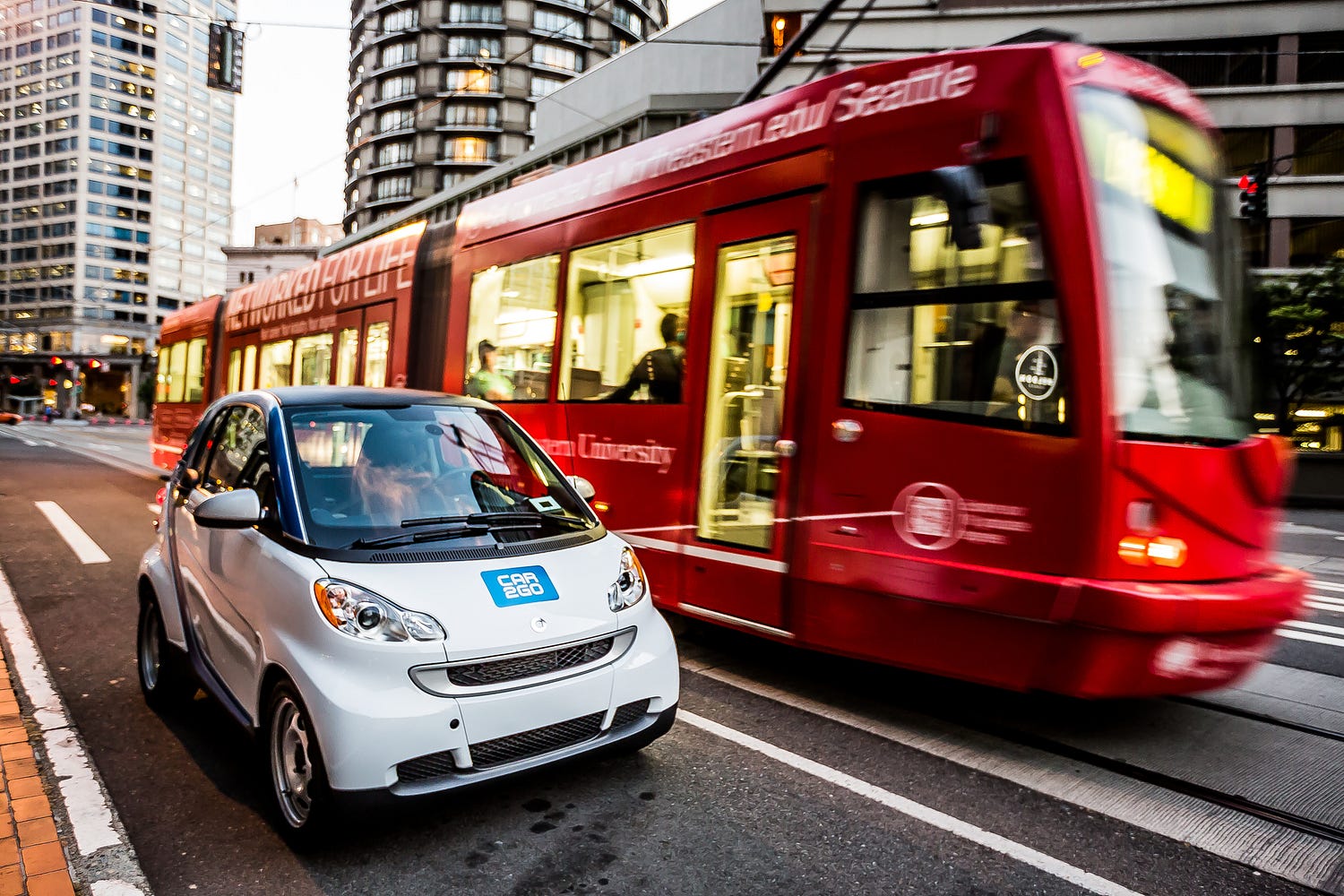
Car sharing and public transit are part of an urban transition to mobility as a service.
Image courtesy of car2go North America.
The sum of these trends is far greater than the parts, and point to a very different future of new mobility with four elements at the core.

The first is mobility as a service. “We’re going to share cars,” says Weiland. “They’re going to be running 12-hour days at very high levels of utilization.” Since the mobility is there when you need it and not when you don’t, it’s essentially “mobility on demand,” like streaming your favorite movie. And when you’re not committed to a single vehicle (the one you own in your garage today, perhaps) then the mobility-as-a-service perspective opens up all sorts of possibilities to you — walking, biking, Ubering, Lyfting, a self-driving car, buses, trains. The new mobility gets you where you want, when you want, how you want.

Underlying mobility as a service is using the right vehicle for the right job. Forget giant SUVs with third-row seats shuttling a single person. The vehicles of the future — a future that will take shape in the next five to ten years, the RMI team says — will be a diverse lot, built for diverse needs. Comfy one-seaters could carry commuters between their homes and bus or train stations, finally cracking the infamous “last-mile” problem that has long vexed transit planners. SUVs might carry people to the mountains or the beach, pickup trucks to Home Depot and back. Minibuses might make sense where big buses now trundle along mostly empty (and thus costing up to 90 cents a passenger mile in many municipalities, says Jonathan Walker, a manager in RMI’s mobility practice).

The vehicles of this future will also be electrified. Why? In a high-utilization mobility future — where fewer vehicles are driving more miles and more hours of the day — operating costs dominate their total cost. That’s one place where electric vehicles (EVs), with an average 120 MPGe, have a huge leg up over gasoline-burning cars, because their drastically lower “fuel” cost more than offsets their higher purchase price. And, since EVs also have far fewer moving parts, Weiland says they can go 300,000 or maybe even 500,000 miles, compared to 150,000 miles on the average late model car. The combination of robustness and low maintenance costs makes EVs ideal for high-volume shared services. That includes corporate fleets, where EVs can seriously trim a company’s operating costs and carbon footprint.

In the new mobility, much higher utilization rates mean we’ll need far fewer cars to move more people more efficiently in less traffic with less cost and less climate impact.

Then there are the aforementioned self-driving vehicles. At first blush, self-driving capability might sound like another cool feature. For maybe $10,000 — the Boston Consulting Group’s estimate for the added cost of that capability and the actual price of California startup Cruise Automation’s Audi self-driving add-on — you can let your car drive you. Catch up on the news, read a book, do some work, take a nap. But think about it: if the car can drive you, why have it just park itself and wait all day for you? Why not share it, let it transport others rather than sit parked waiting for you? Self-driving vehicles thus only further support mobility as a service provided through ubiquitous retail fleets, instead of individually-owned cars.

Finally, there’s mobility-friendly cities, says Greg Rucks, a principal in RMI’s mobility practice. Today’s urban landscapes are built around the automobile: streets clogged with traffic; drivers circling city blocks searching for parking; curbside, garage, and underground parking. Mobility-friendly cities, on the other hand, can trade excess road capacity and parking for more parks… or homes or shops or anything other than catering to the almighty automobile.
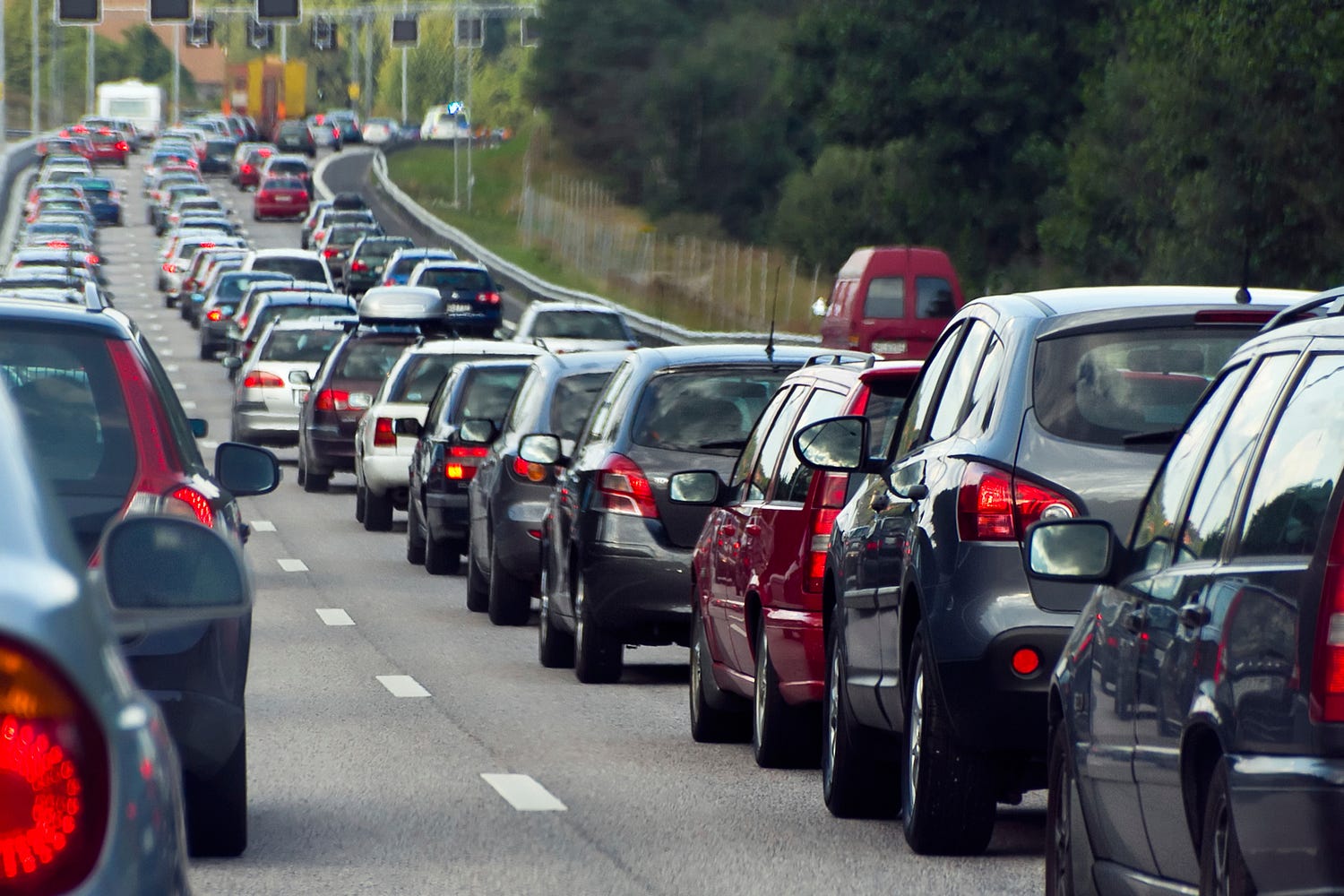
Image copyright Thinkstock / alexandragl1.

The Journey of a Thousand Miles…

There are currently about 253 million registered cars and light-duty trucks on the road in the U.S. With a 2014 population of 319 million, that’s almost one car per person! That won’t be the case in the new mobility, where much higher utilization rates mean we’ll need far fewer cars to move more people more efficiently in less traffic with less cost and less climate impact. Of course, arriving at such a mobility Shangri-La won’t happen overnight, and it won’t be easy.

Weiland, Rucks, Walker, and the rest of the team believe we can reduce the number of urban/suburban vehicles on the road by up to 90 percent. Along the way, we will redefine cities and, probably, American life, just as the horseless carriage once did. The barriers will be formidable. Automakers, insurance companies, and other incumbents won’t be excited to cede 90 percent of a market, Weiland says, and would need to develop completely new business models to stay competitive — just as today’s electric utilities are facing with the rise of rooftop solar.

Psychology may prove a bigger hurdle than technology. People like the idea of being able to spontaneously take off somewhere in their own wheels, whether they do it very often or not. Plus, consumers may be slow to trust self-driving technology and reluctant to cede the steering wheel to a computer “brain” under the hood that’s wirelessly connected to the mobility world around it — even though self-driving cars are already safer than cars with human drivers. Data privacy could be a concern, too, though Rucks says the data at the heart of the new mobility would be anonymized. It’s not your personal secrets that matter, he adds, but rather “the aggregation of data in and across systems.”

“We have to devise a solution that’s 100-percent failsafe,” Weiland says. “The new mobility has to offer people a complete answer, not a partial one. Otherwise you’re not going to get rid of your car.” Or at least one of them as a starting point.

Nobody, the RMI team included, knows where exactly this all might go, and that’s not the point, Walker says. “We want to whet the appetite of businesses to go attack these trillion bucks,” he says. The road ahead looks very different from the one behind. But the question now is who will chart the course, who will come along for the ride, and who will be left standing on the side of the road.

Written by Todd Neff, a freelance writer who specializes in covering energy and climate. He wrote about retail electricity pricing in the Summer 2014 issue ofSolutions Journal.


Monday, 10 August 2015


Healthy Eaters, Strong Minds: What School Gardens Teach Kids

Paige Pfleger  ::  NPR  ::  10 August 2015

Tall brick walls conceal a colorful garden at Eastern Senior High School in
Washington, D.C., where students like Romario Bramwell, 17, harvest flowers
and produce. The program is run by City Blossoms, a nonprofit that brings
gardens to urban areas.     Lydia Thompson/NPR
School is still out for the summer, but at Eastern Senior High School in Washington, D.C., students are hard at work — outdoors.

In a garden filled with flowers and beds bursting with vegetables and herbs, nearly a dozen teenagers are harvesting vegetables for the weekend's farmers market.

Roshawn Little is going into her junior year at Eastern, and has been working in this garden for three years now. "I didn't really like bugs or dirt," Little says, thinking back to when she got started. "Well, I still don't really like bugs, but I like the dirt," she laughs. She gathers a handful of greens, yanks from the stem and pulls up a baseball-sized beet.

During the summer, Little gets paid to work Tuesday through Saturday from 9 a.m. until 2 p.m. with City Blossoms, a nonprofit that brings community gardens to schools, community centers and other places where kids gather in urban areas.

Little believes that working in the garden has taught her to try all sorts of new things — like eating different kinds of vegetables more often. And she's taken those healthy behaviors home with her. Little brings home vegetables from the garden, and she says her eating habits have encouraged her family to buy more fruits and vegetables.

Yanci Flores (left) and Roshawn Little harvest beets from the garden at
Eastern Senior High School on July 17.  Lydia Thompson/NPR
"We're a chubby family and we love to eat. Well, I do," she adds with a laugh. "We mainly live around liquor stores and snack stores. There aren't that many grocery stores. They're way out, and you have to drive so far" — a common problem in low-income urban areas. "It seems so pointless, when there are snack stores right there," she says.

City Blossoms is one of many groups across the country teaming up with local communities to install school gardens, like the one at Eastern, in areas with low access to fresh, healthy foods. These gardens, advocates say, are really an outdoor classroom where kids learn valuable lessons — not just about nutrition, but also about science and math, even business skills.

By The Books

Many of these groups have big ambitions to tackle complex problems. But there is research that shows the benefits of school gardens can be real and measurable, says Jeanne McCarty, the executive director of REAL School Gardens.

"There's a trend across the country where kids are not spending enough time outdoors, period," McCarty says.

Top Left: Nychele Williams, 15, gathers basil in the garden at Eastern Senior
High School. Bottom left: Yanci Flores rinses recently harvested beets.
Right: Carrots and beets are displayed at the Aya farmers market,
where students sell their produce on Saturdays.  Lydia Thompson/NPR
To counter that, the nonprofit, which operates in Texas and Washington, D.C., Maryland and Virginia, works with schools to create "learning gardens" and trains teachers on how to use them to get students engaged and boost academics. For example, the gardens can be used for math lessons — like calculating the area of a plant bed — or learning the science of how plants grow.

McCarty says REAL School Gardens — which has built nearly 100 gardens — is constantly evaluating the outcomes of its programs, and the numbers are encouraging.

She says partner schools have seen a 12 to 15 percent increase in the number of students passing standardized tests — not just those in the garden program, but schoolwide.

Students at Eastern Senior High School in Washington, D.C., trim
bouquets to sell at the farmers market.  Lydia Thompson/NPR
And 94 percent of teachers in the REAL School Garden programs reported seeing increased engagement from their students, according to an independent evaluation conducted by PEER Associates and funded by the Rainwater Charitable Foundation.

She says the benefits don't end with the students, either. Schools that installed learning gardens saw less teacher turnover, McCarty says.

Principal Margie Hernandez tells us she's seen the effect firsthand among her teachers.

"They start realizing that they need something to invigorate themselves, so they can invigorate their classrooms and invigorate their students," she says. Her school, Pershing Elementary in Dallas, has worked with REAL School Gardens since 2011.

Rebecca Lemos-Otero (right), co-founder and co-executive
director of City Blossoms, helps Erwin Tcheliebou, 15,
pick flowers to sell at the farmers market. Behind her is a
wall featuring the painted portraits of Eastern Senior High
students who have worked in the garden.  Lydia Thompson/NPR
And for her students — who come from predominantly low-income backgrounds — the experience can be a nutritional eye-opener, Hernandez says. "It totally changed my kids' perceptions of where food comes from, and what it takes to produce food."

If They Grow It, They'll Eat It

Many studies have found that kids are more likely to eat fruits and vegetables if they help garden them. That's part of the motivating principle behind Colorado-based Denver Urban Gardens, or DUG, a school garden program that puts a heavy emphasis on having kids taste the produce they grow.

DUG has 13 garden programs at schools where more than 90 percent of the students qualify for free and reduced-price lunches. Some of the produce that students grow then gets sold to the school cafeteria. That way, kids can recognize the fruits (and vegetables) of their labor in the lunch line. DUG has found that 73 percent of the students who work in the school garden reported increasing their actual consumption of produce.

Rebecca Andruszka, who works with DUG, says her friend's children will only eat vegetables from the garden at school — not from the grocery store.

"I think it's just that it seems less foreign when you're a part of the growing process," Andruska says.

A Business Education

In D.C., the kids of City Blossoms are also part of the business process: They take their produce to farmers markets.

On a recent weekend at the Aya farmers market in Southwest D.C., the kids' table is decorated with handmade signs that read "onions" and "garlic," with little pictures drawn beside them. The kids greet customers warmly, shaking their hands and calling them "sir" or "ma'am."

Roshawn Little mans the table, inviting people to try their herbed salt with bread. Working at the market has helped her practice her public speaking skills, she says. Plus, it teaches her business and money skills.

Roshawn Little (left) invites customer Nate Kohring to try the herbed salt
with bread at the Aya farmers market on Saturday.  Lydia Thompson/NPR
"I used to spend money on anything, mainly junk food," Little says. "Now, as I'm working here, I learned how to use my money more responsibly."

Homemade signs decorate the table at the Aya farmers market,
where the kids of City Blossoms sell their produce
on Saturdays.  Lydia Thompson/NPR

Nadine Joyner of Nutrition Synergies LLC, a nutrition education company, has a booth next to the kids at the market. She often buys produce from them to incorporate into her quiches. She says she's constantly impressed by the kids' knowledge of what they're selling — they know how to grow it, how to prepare it, and how to cook it.

"It's a very impressive thing to see young urban entrepreneurs," Joyner says, looking over at the kids. "It's a refreshing thing."

Joyner believes that teaching young people the importance of healthy eating will have long-term payoffs.

"The payoff is exponential, because they'll be young mothers or young fathers someday, and they'll feed their children based on what they've learned now," she says.

Students from Eastern Senior High School in Washington, D.C.,
sell vegetables, soaps and salts at the Aya farmers market
on July 25.  Lydia Thompson/NPR
But the kids aren't thinking of that bigger picture. Instead, they're just enjoying the little things, like the way their hands smell after harvesting herbs, or the satisfying crunch of a freshly picked carrot.

Saturday, 8 August 2015

Solar-Powered Noise Barriers Quiet Traffic While Generating Electricity

  ::  EcoWatch  ::  3 August 2015 
From the country that brought you the solar road comes solar noise barriers. Highway noise barriers are usually not very aesthetically pleasing and only serve one purpose—to quiet traffic for the surrounding community. But a researcher in the Netherlands, Michael Debije at the Eindhoven University of Technology, is trying to change all that.
Since April, Debije has launched two pilot projects along the A2 highway in the Netherlands to test a new kind of solar panel he has developed. Using an innovative technology known as luminescent solar concentrators (LSC), the translucent sheets “bounce light internally to the edges of the panels, where it is beamed onto regular solar panels in concentrated form,” saysFast Coexist. The year-long pilot project will help determine how well the barriers hold up in terms of power generation capabilities and with vandal-resistance and maintenance requirements.
Because the barriers are so aesthetically pleasing and translucent, they could be used in urban areas to reduce noise pollution. Photo credit: Eindhoven University of Technology
The panels are ideal for the gray skies of Northern Europe because they work even on cloudy days. A single half-mile stretch can provide enough electricity to power 50 homes.
“The LSC panels can be made in different colors, so the result is something like an oversized stained-glass window,” says Fast Coexist. “Because light can shine through them, they could be used in urban areas, shielding noise without making either pedestrians or motorists feel cut off.”
Debije says thanks to recent breakthroughs with LSC panels, they are now a commercially viable product. Photo credit: Eindhoven University of Technology
Debije and his team published a paper in Nature this spring that shows how they have overcome previous problems with LSC panels, and the team now claims they are commercially viable, according to Tech Times. “Further benefits are that the principle used is low cost, they can be produced in any desired, regular color, is robust, and the LSCs will even work when the sky is cloudy,” Debije told Tech Times. “That means it offers tremendous potential.”

Wednesday, 5 August 2015


A Community Built Around Older Adults Caring For Adoptive Families

Ina Jaffee  ::  NPR Morning Addition  ::  04 August 2015
Whitney Gossett (seated, center) sits with her children (clockwise) Jeremiah, 7, Andrew, 12,
Patrick, 13, and Bella, 10 — along with her fiance Brad Burtcher.Ina Jaffe/NPR
Families who adopt foster kids need a lot of support. In Rantoul, Ill., families get help in a neighborhood called Hope Meadows from older adults who've moved there just for that purpose.

The Gossett family has definitely benefited from this arrangement. Whitney Gossett adopted four siblings from foster care: brothers Patrick, 13, Andrew, 12, Jeremiah, 7, and sister Bella, who's 10.

"It's a good thing that they all got to stay together," she says. "They were talking about having to split 'em all apart and send them to different places until I told them I wanted all of 'em."

Soon there will be a dad in the picture: Gossett's fiancé, Brad Burtcher.

"We just got together in January, but we're getting married in September, and I plan on adopting all of them. So they're my children," Burtcher says. "These are my kids."

But for a few years, it was just Gossett. "I went from single and no kids to having four. It was a big step, but it was well worth it," she says.

Hope Meadows (formerly Generations of Hope) was established 21 years ago to make sure that parents like Gossett wouldn't have to take that big step alone. Of the roughly 40 houses currently rented in Hope Meadows, only 10 are occupied by families who've adopted children from foster care. The rest are occupied by older adults. They get a break in rent for volunteering six hours a week. But a lot of them do more than that.

Carol Netterfield, 70, is one. Miss Carol, as the kids call her, meets Bella Gossett in the community center to teach her to cross stitch. Bella is making a big red heart.

"I wanted to learn how to do this because my mom is getting married, and this card is for her and her fiancé," she says.

Netterfield says she and Bella go back a long time. When Bella was around 5, she started taking her to story time at the library.

"But this little one didn't like story time," recalls Netterfield. "She wanted to read herself. She was hungry to read." And Bella's not finicky. She says she likes "most books."

An Adaptable Model

Brenda Krause Eheart founded Hope Meadows 21 years ago.Ina Jaffe/NPR
In recent years, communities modeled on Hope Meadows have been created in Oregon, Florida and Massachusetts. And a project called Genesis is under construction in Northwest Washington, D.C. It's adapting the Hope Meadows idea for young women aging out of the foster care system, all of them mothers of small children.

Fernando Lemos is the executive director of Mi Casa, the nonprofit developer that's building Genesis with a combination of public and private funds. "The goal of the program is to put together the two elements, the seniors with the teen mothers, to form a community and to support each other," Lemos says.

Actually, the teen mothers he refers to are not teens anymore. In Washington, D.C., kids age out of foster care at 21.

"Everyone will have to offer at least 100 hours [of volunteer service] every 3 months," Lemos says.

For example, the young mothers can take the seniors to the doctor, and the seniors can help out with child care while the moms are at school or at work. Lemos says that will "provide the support that the [young] mothers need to be successful in the outside world."

There are half a dozen more of these Hope Meadows-inspired communities in the planning stages. In two of them, seniors will be the neighbors of adults with developmental disabilities. And in New Orleans, older adults will live next door to veterans with traumatic brain injuries.

"I am so convinced that we have to do so much more to utilize the time and talents of older adults to address these social problems," says Brenda Krause Eheart, the former University of Illinois professor who founded Hope Meadows. 

Now she heads the Generations of Hope Development Corporation, which doesn't actually develop properties but works with those groups establishing similar communities across the country. She says originally, Hope Meadows was just intended to be maybe a dozen families adopting children from the foster care system who would offer each other mutual support.

"I just kept thinking about these [foster] children. I wasn't thinking about older adults at all," she recalls.

I am so convinced that we have to do so much more to utilize the time and talents of older adults to address these social problems.

Brenda Krause Eheart, heads the Generations of Hope Development Corporation

Eheart had been trying to get just 12 houses in Rantoul, Ill., on the Chanute Air Force Base when it was shutting down. But "They said, 'No, we're breaking this base into units,' " she says, "and they said 'you gotta take 82 housing units.' "

Did it ever. "I can tell you that if it weren't for the older adults, that program would have collapsed, absolutely would've collapsed," Eheart says.

A 'Hard Time' 

As the sun is setting, the Gossett boys are having dinner at the home of another Miss Carol — 72-year-old Carol Veit. And for the first time ever, 12-year-old Andrew is confronting eggplant that has not been breaded and fried.

"Try it," Veit encourages.

"But it's brown!" exclaims Andrew. "It looks like mushrooms."

"Put it in your mouth!" Veit implores. "C'mon, it's a little tiny piece."

This argument can only happen between people who are really used to each other. Veit has the Gossett boys to dinner almost once a week. They use her iPad to look up recipes to make.

"They can make anything they want that doesn't turn on the oven 'cause it's summer time and that's not sweet 'cause their parents don't like that," she says.

But Andrew doesn't wait until the weekly dinners to see Miss Carol. "I bug Miss Carol every day," he says with a grin. "In fact, Thursday is my day to bug her all day." That happens down at the Hope Meadows office where she works on Thursday mornings. "And I'm bugging her from the time I get down there until 1 o'clock," Andrew says, barely mentioning that he also helps her get out the community newsletter.

Before she retired, Veit was a physical therapist in schools in the El Paso area. So she's been around kids her whole life.

"Yeah, I knew what they were like before I got here," she says with a laugh. "And they were what I expected."

Thirteen-year-old Patrick agrees: "Yeah, a hard time."

But they're the kind of "hard time" you only give someone when you know them well — and you really care about them.


Thursday, 16 July 2015

Urban Farming Hits Major League Baseball Stadiums

   ::  EcoWatch  ::  16 July 2015 
As fans sitting on the third baseline streamed into Boston’s Fenway Park for the Red Sox home opener, they were greeted with the sight of 1,800 square feet of raised beds on a formerly unused 5,000-square-foot rooftop. “Fenway Farms” initially will grow fresh vegetables not typically found in baseball stadiums—arugula, Swiss chard and broccoli rabe, for instance—for use by the chefs at the EMC Club kitchen, just 25 feet away.
Photo credit: Maureen White
Boston’s Fenway Park has 1,800 square feet of raised beds on a formerly unused 5,000-square-foot rooftop. Photo credit: Maureen White
The ballpark may not conjure images of health and sustainability—and certainly not innovation in urban agriculture—but a handful of Major League clubs just may change that, and in the process give new meaning to “farm teams.” This season, the Red Sox join the Colorado Rockies, the San Diego Padres and the San Francisco Giants in starting to grow a portion of their stadium concessions in on-site farms and gardens.
The farm’s location is highly visible to many of the roughly 37,000 fans who fill the ballpark for the team’s 81 home games and the handful of concerts and other events to which Fenway plays host—a potential influence that is not lost on Chris Knight, the team’s manager of facility planning and services.
“We have such a platform here at this level of sports and at Fenway Park—this is one way we can make an impact for the environment and nutrition,” he said.
When the first vegetables and herbs were harvested in early May, Fenway Farms contributed its part to a long-term push at the ballpark to operate more sustainably—and a more recent emphasis on integrating healthy food into concessions. Knight said the idea for the farm came from Linda Pizzuti Henry, wife of Sox co-owner John Henry. Last summer, the founders ofGreen City Growers—a company converting unused space into farms and gardens—met with Henry to pitch ideas for turning that dream into a reality.
The process “picked up quickly” from there, said Green City Growers founder, Jessie Banhazl, with the team picking out a site on the front-office roof and growers meeting with chefs at the seasonally inspired EMC Club to come up with a lineup of veggies to grow. Recover Green Roofs began construction and farm installation in mid-March, and plants went into the newly poured soil last week—just in time for the first home game of the season.
Photo credit: Maureen White
“It’s wild. We’re really, really, really excited about this,” said Banhazl, whose company will maintain the farm. “This particular project is the coolest and most widespread reach that we’ve ever seen with an urban agriculture project.”
The foray by the Red Sox into urban agriculture is unusual among modern professional baseball teams—but the team is not the first to catch the grow-your-own bug. In 2012, at the stadium chef’s request, San Diego Padres head groundskeeper Luke Yoder planted more than a dozen hot pepper and tomato plants in the Petco Park bullpen. In 2013, the Colorado Rockies, working with their catering contractor, Aramark, installed a 600-square-foot kitchen garden near Gate A at Coors Field, which sprouts an assortment of flowers, herbs, and other vegetables. Much of the food harvested from “The GaRden” is found in dishes at the stadium’s premier Mountain Ranch Club.
Last season, the San Francisco Giants and Bon Appétit Management built The Garden at AT&T Park, a 4,320-square-foot dining pavilion serving produce grown in several nearby gardens and a high-yield vertical farm. (There was even a bit of controversy when the Padres took issue with Giants’ marketing claiming to have the majors’ first farm, claims that were later retracted). The Garden pavilion contains two food concepts: The Hearth Table uses only gluten-free ingredients, while The Garden Table serves vegetarian offerings. Bartenders even integrate fresh-grown herbs into the cocktails. Don’t worry, you can still get your all-beef hot dog at The Garden, but Laura Braley, spokesperson for Bon Appétit Management, said the ballpark simply wants to provide alternatives for fans seeking a more nutritious meal and sees the on-site farm as a way to inspire fans to think about the source of their food.
Photo credit: Maureen White
“It’s fun to get a salad or a flatbread and literally see the ingredients growing right there,” she said, adding that prices in The Garden have remained consistent with other offerings at AT&T Park.
While the Sox, Rockies, Padres and Giants lead the majors in progressive food and nutrition policies, other clubs appear to be competing for the most outrageous offerings on the other end of the health spectrum. At Rangers Stadium in Texas, for instance, fans this season will be able to dine on a deep-fried “S’mOreo” (exactly what it sounds like), chicken-fried corn on the cob, and bacon-flavored cotton candy. The Arizona Diamondbacks this season introduced theChurro Dog: a churro inside a chocolate-frosted long-john doughnut, topped with ice cream, whipped cream, and both chocolate and caramel syrups.
Photo credit: Green City Growers
Make no mistake: Sox and Giants fans still have their pick of less-than-nutritious stadium foods. Neither club would provide data on how well their healthier offerings have been selling, but a 2014 study of a healthy-food overhaul of a concession stand at a high-school athletics facility found that the changes had no negative effect on concessions sales and even improved overall satisfaction among parents. Varsity football is a world away from Major League Baseball, sure, but with dining trends tend toward healthier food nationally, there is both interest and demand that these programs could tap into.
Besides nutritional and environmental goals for their farms, the Giants and Red Sox have strong educational outreach programs. The Giants earlier this year unveiled plans to use The Garden at AT&T Park as an outdoor nutrition and agricultural classroom for children on non–game days, giving kids a chance to learn the importance of healthy eating. Boston has similar plans for youth enrichment—and even dreams of farming in other parts of the ballpark—as soon as farm operations are streamlined and crops are coming up.
While the first veggies won’t be ready to harvest for a few more weeks, Banhazl said she caught glimpses of the the farm’s potential influence on opening day. As she watched child after child run up to the railing and see the new beds for the first time, she saw something come alive in them.
“They’d say, ‘Oh my God, the Red Sox have a farm?’” she recalled. “We should do this, Mom!”

Saturday, 6 December 2014

Texas Town Sues to Uphold Fracking Ban, Protect Democracy

Anastasia Pantsios  ::  EcoWatch  ::  5 December 2014 

The little guys aren’t taking this one lying down. In November, voters in Denton, Texas—fed up with oil and gas drilling companies unwilling to work with citizens to put some reasonable protections in place and with state and local regulators for allowing new fracking wells near homes, schools, parks and hospitals—passed a ban on fracking, despite being hugely outspent. The Texas Oil and Gas Association, representing the fracking companies, and the state’s General Land Office responded with lawsuits to protect their “right” to push fracking on unwilling residents.

Even kids can’t help noticing the impact of fracking on their community.
Image credit: Frack Free Denton

Now Denton is fighting back with lawsuits of its own. Yesterday, with the fracking ban taking effect on Tuesday, the Denton Drilling Awareness Group (DAG) and Earthworks, the groups that led the Frack Free Denton ballot initiative, filed intervention papers in both lawsuits, seeking to assert the right of citizens to decide what happens in their own neighborhoods. The groups are represented by the Texas local government law firm Brown & Hofmeister; attorneys from national environmental organizations Earthjustice and the Natural Resources Defense Council are asking the permission of the court to act as co-counsel.

“Denton residents, with Republican and Democratic majorities, voted overwhelmingly to ban fracking,” said DAG president Cathy McMullen. “Our city has the legal power to prevent bakeries from setting up shop in residential neighborhoods. To suggest that we don’t have the legal power to similarly bar fracking, a much more dangerous process, is the height of industry arrogance.”

“The state and industry could have respected Denton communities’ health, safety and property,” said Earthworks’ energy program director Bruce Baizel. “They chose not to. The ban is the result. Now, rather than constructively engage with the community, they simply overlook their regulatory failure and move to overturn democracy through legal action.”

Fracking wells are literally in residents’ back yards.
Photo credit: Frack Free Denton

At issue is whether local communities have the right to regulate oil and gas operations within their borders or whether, as the lawsuits by the oil and gas interests claim, Denton’s voter-approved ordinance is overridden by state regulators in contradiction of Texas’ long tradition of home rule authority over gas and oil development. There are many other local oil and gas regulations in effect across Texas, including in Dallas just to the south of Denton, which seems to contradict the contention of the frack-friendly interests.

“The State of Texas has granted municipalities the right to oversee oil and gas operations,” Earthjustice managing attorney Deborah Goldberg pointed out. “The people of Denton have exercised that right, and we intend to help preserve it. Communities from California to Texas to New York are fed up with the abuses of the oil and gas industry. When state and federal officials won’t stand up for the public, citizens must have the right to use local democracy to protect themselves.”

Denton citizens mobilized to ban fracking in their community
and aren’t going to back down in the face of gas and
oil companies’ lawsuits. Photo credit: Frack Free Denton

“This fight cuts to the heart of our democracy, and it is far from over,” said Natural Resources Defense Council attorney Dan Raichel. “The people of Denton have voted to keep fracking away from their homes and schools—they will not be bullied by powerful oil and gas companies that want to make a profit at the expense of their health. Denton is a pioneer in Texas, but it is not alone. This community joins hundreds of others around the country—and in Texas—that are demanding the right to determine what happens within their own borders.”

This article sums up the elephant in the room when it comes to the fracking industry and its effect on individuals and communities.  The proponents of the fracking industry see nothing wrong with concept of industrializing (sacrificing) 1/7 of the provincial land mass, numerous communities and villages, and the assets of individuals for the benefit of a foreign corporation and a small select group of individuals.  Even if the fracking industry were not inherently dangerous, toxic and promoting climate change, the industry is not feasible unless the process has not limits.  Should not this industry be forced to compensate the individuals, towns and villages affected, i.e. purchase the land mass that they need in lieu of royalties? Should not individuals, villages and towns be able to say yes or no to what industries they wish to have as neighbours?    Richard Lachance

Wednesday, 26 November 2014

NOVA:  Material World

In the early 1990s, after hearing a story about "Material Girl" Madonna's latest self-promotional enterprise, photojournalist Peter Menzel had a vision: Rather than take viewers into the mansions of the rich or the "cribs" of MTV celebrities, he wanted to capture the material life of average families around the globe. His resulting book, Material World, offers extraordinary images of families in front of their dwellings with all (or nearly all) of their possessions. Experts at the United Nations and World Bank helped determine the criteria for average families according to location (urban, rural, suburban, small town, or village), type of dwelling, family size, annual income, occupation, and religion. Here, we present five of the photographs Menzel and his team produced, along with updated statistical data for each country.—Susan K. Lewis

What’s Enough?
Consumerism may be good for the economy, but it contributes to resource depletion, climate change and other environmental challenges.  Perhaps worse, consumerism has led us to worship stuff: it seems the more we have, the better.  The cost has been an erosion of our spirituality, our relationships and our sense of community.
Maybe there is a better way - one that involves pondering our own interpretation of what's 'enough'. 


China:  The Wu Family

The nine members of this extended family—father Wu Ba Jiu (59), mother Guo Yu Xian (57), their sons, daughters-in-law, and three grandchildren—live in a three-bedroom, 600-square-foot dwelling in rural Yunnan Province. While they have no telephone, they get news and images of a wider world through two radios and the family's most prized possession, a television. In the future, they hope to get one with a 30-inch screen as well as a VCR, a refrigerator, and drugs to combat diseases in the carp they raise in their ponds. Not included in the photo are their 100 mandarin trees, vegetable patch, and three pigs.

China Stats
Population: 1.3 billion
Population density: 627 people per sq. km.
Total fertility rate: 1.7 children per woman
Population doubling time: 67 years
Percentage urban/rural: 37% urban, 63% rural
Per capita energy use: 905 kg. oil equivalent
Infant mortality: 32 deaths per 1,000 births
Life expectancy: 69 (male), 73 (female)
Adult illiteracy: 7.9% (male), 22.1% (female)
Internet users: 46 million

India:  The Yadev Family

At age 25, Mashre Yadev is already mother to four children, the oldest of whom was born when she was 17. Each morning at their home in rural Uttar Pradesh, she draws water from a well so that her older children can wash before school. She cooks over a wood fire in a windowless, six-by-nine-foot kitchen, and such labor-intensive domestic work keeps her busy from dawn to dusk. Her husband Bachau, 32, works roughly 56 hours a week, when he can find work. In rough times, family members have gone more than two weeks with little food. Everything they own—including two beds, three bags of rice, a broken bicycle, and their most cherished belonging, a print of Hindu gods—appears in this photograph.

India Stats
Population: 1.0 billion
Population density: 318 people per sq. km.
Total fertility rate: 3.0 children per woman
Population doubling time: 36 years
Percentage urban/rural: 28% urban, 72% rural
Per capita energy use: 494 kg. oil equivalent
Infant mortality: 66 deaths per 1,000 births
Life expectancy: 62 (male), 64 (female)
Adult illiteracy: 32% (male), 55% (female)
Internet users: 7 million

Japan:  The Ukita Family

Like many Japanese women, 43-year-old Sayo Ukita had children relatively late in life. Her youngest daughter is now in kindergarten, not yet burdened by the pressures of exams and Saturday "cram school" that face her nine-year-old sister. Sayo is supremely well-organized, which helps her manage the busy schedules of her children and maintain order in their 1,421-square-foot Tokyo home stuffed with clothes, appliances, and an abundance of toys for both her daughters and dog. She and her husband Kazuo, 45, have all the electronic and gas-powered conveniences of modern life, but their most cherished possessions are a ring and heirloom pottery. The family's wish for the future: a larger house with more storage space.

Japan Stats
Population: 128 million
Population density: 336 people per sq. km.
Total fertility rate: 1.3 children per woman
Population doubling time: 289 years
Percentage urban/rural: 79% urban, 21% rural
Per capita energy use: 4,316 kg. oil equivalent
Infant mortality: 3 deaths per 1,000 births
Life expectancy: 78 (male), 85 (female)
Adult illiteracy: 1% (male), 1% (female)
Internet users: 56 million

Mali:  The Natoma Family

It is not unusual in this West African country for men to have two wives, as 39-year-old Soumana Natomo does. More wives mean more progeny—and a greater chance you will be supported in old age. Soumana now has eight children, and his wives, Pama Kondo (28) and Fatouma Niangani Toure (26), will likely have more. How many of these children will survive, though, is uncertain: Mali's infant mortality rate ranks among the ten highest in the world. Some of the family's possessions are not included in this photo—another mortar and pestle for pounding grain, two wooden mattress platforms, 30 mango trees, and old radio batteries that the children use as toys. (Note: The Natomos appear on the adobe roof of their house in Kouakourou. An infant son is nestled in his mother's arms. One daughter is absent.)

Mali Stats
Population: 12 million
Population density: 9.1 people per sq. km.
Total fertility rate: 7.0 children per woman
Population doubling time: 23 years
Percentage urban/rural: 26% urban, 64% rural
Per capita energy use: 22 kg. oil equivalent
Infant mortality: 118.7 deaths per 1,000 births
Life expectancy: 48 (male), 49 (female)
Adult illiteracy: 64% (male), 84% (female)
Internet users: 30,000

United States:  The Skeen Family

Rick and Pattie Skeen's 1,600-square-foot house lies on a cul-de-sac in Pearland, Texas, a suburb of Houston. The fire hydrant in this photo is real, but not working—a souvenir from Rick's days as a firefighter. Rick, 36, now splices cables for a phone company. Pattie, 34, teaches school at a Christian academy. To get the picture, photographers hoisted the family up in a cherry picker. Yet the image still leaves out a refrigerator-freezer, camcorder, woodworking tools, computer, glass butterfly collection, trampoline, fishing equipment, and the rifles Rick uses for deer hunting, among other things. Though rich with possessions, nothing is as important to the Skeens as their Bible. For this devoutly Baptist family, like many families around the world, it is a spiritual—rather than material—life that matters most.

U.S. Stats
Population: 292 million
Population density: 29 people per sq. km.
Total fertility rate: 2.0 children per woman
Population doubling time: 116 years
Percentage urban/rural: 78% urban, 22% rural
Per capita energy use: 8,148 kg. oil equivalent
Infant mortality: 6.7 deaths per 1,000 births
Life expectancy: 74 (male), 80 (female)
Adult illiteracy: 3% (male), 3% (female)
Internet users: 165 million